Why is Asset Data Is Becoming One of Council’s Most Valuable Assets
How Governance, Standardisation and Shared Thinking Are Helping Councils Build Smarter Asset Information Environments
Across Australia, councils are managing increasingly complex asset portfolios while operating under growing financial, operational and governance pressure.
From roads and bridges to buildings, parks, drainage networks and community infrastructure, councils rely on asset information every day to support decision-making, service delivery and long-term planning.
Yet many local governments continue to face a common challenge fragmented asset systems, inconsistent data structures, disconnected workflows and limited governance around asset information management.
As organisations pursue digital transformation and stronger asset management maturity, one thing is becoming increasingly clear – asset data has become one of an organisation’s most valuable strategic assets. The ability to capture, govern, maintain and utilise trusted asset information is now fundamental to effective decision-making, service delivery, risk management and long-term financial sustainability. The recent CT Management Group presentation at the IPWEA Victoria Public Works Conference 2026 highlighted that successful Asset Information Management is not just about implementing new technology it is about governance, collaboration, standardisation and building trusted information environments that support better long-term decisions.
This blog explores:
- Why fragmented asset systems create operational risk
- Why governance often fails before technology does
- The key elements of effective Asset Information Management
- Why governance is the foundation of trusted asset information
- What ISO 55013 means for councils
- Why shared services and regional collaboration matter
- Lessons learned from the T3C regional collaboration model
- Why councils should treat asset data as a strategic organisational asset
- How CT Management Group supports governance-first Asset Information Management
The Reality: Many Councils Are Still Managing Fragmented Asset Information Environments
Across the sector, many councils continue to operate with:
- Different systems, configurations and workflows
- Inconsistent asset data and hierarchy structures
- Limited interoperability between systems
- Duplicate reporting and manual processes
- Resource and capability constraints
- Limited benchmarking and shared insights
These challenges create operational inefficiencies and make it difficult for councils to establish trusted, evidence-based decision-making frameworks.
Importantly, the issue is often not the software itself. The issue is that governance, processes, standards and organisational alignment have not matured alongside the technology.
This is why many Asset Information Management projects struggle to deliver long-term value.

Governance Often Fails Before Technology Does
One of the strongest themes emerging across the local government sector is that technology alone will not solve asset information challenges.
Without governance, even the best systems can become fragmented over time.
Councils often face challenges such as:
- Unclear ownership of asset information
- Inconsistent data standards
- Different terminology across departments
- Lack of defined roles and responsibilities
- Poor lifecycle management of asset data
- Limited integration between systems and business functions
These issues reduce confidence in the quality and reliability of asset information ultimately impacting strategic planning, reporting and investment decisions.This is why governance-first Asset Information Management is becoming increasingly important across local government.
The Key Elements of Effective Asset Information Management
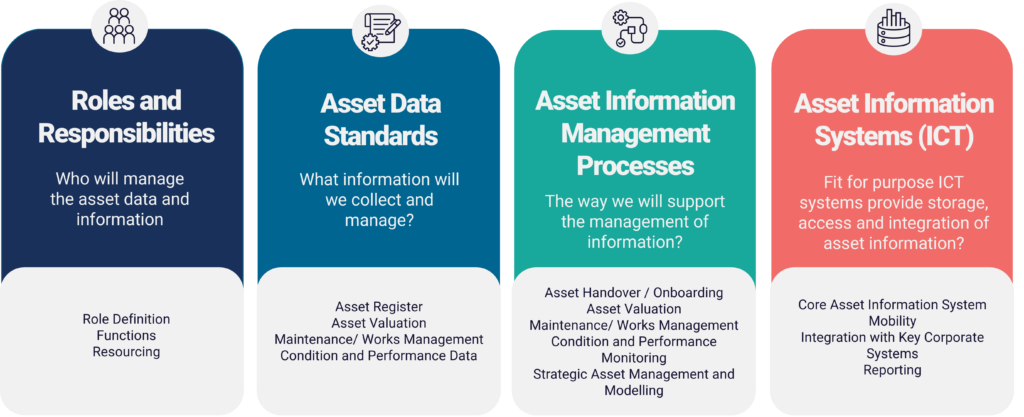
A successful Asset Information Management (AIM) environment requires more than technology alone. It relies on a coordinated framework that brings together governance, people, processes, systems and data to create trusted information that supports decision-making across the organisation. Through years of working with councils and asset-intensive organisations, several core Asset Information Management elements have emerged as critical to success.
Asset Information Systems
Asset Information Systems provide the technological foundation for storing, managing and reporting asset information. These systems support operational activities, planning, reporting and decision-making across the asset lifecycle. However, technology should be viewed as an enabler, not the solution itself. Without appropriate governance and supporting processes, even the most sophisticated systems can fail to deliver value.
Asset Information Governance
Asset Information Governance sits across all Asset Information Management activities and provides the framework for ownership, accountability, decision-making and continuous improvement.
Strong governance helps councils:
- Define ownership of asset information
- Establish accountability across the organisation
- Ensure consistency of standards and processes
- Manage information quality and integrity
- Support compliance and audit requirements
- Build confidence in decision-making
Without governance, asset information often becomes fragmented, inconsistent and difficult to trust.
Asset Information Business Systems
Effective Asset Information Management requires clearly defined business processes that govern how asset information is created, maintained, updated and utilised.
These processes should align with organisational objectives and ensure that information remains accurate, accessible and relevant throughout the asset lifecycle.
Asset Information Roles and Responsibilities
Successful Asset Information Management depends on clear ownership and accountability.
Councils should establish defined roles and responsibilities for:
- Data custodianship
- Information stewardship
- System administration
- Quality assurance
- Reporting and analytics
- Governance oversight
Clearly defined responsibilities help ensure consistency and accountability across departments and business functions.
Asset Data Standards
Asset Data Standards provide the structure that enables consistency, interoperability and trust in asset information.
Data standards typically define:
- Asset hierarchies and classifications
- Naming conventions
- Data formats and structures
- Mandatory data fields
- Condition and performance information
- Lifecycle and financial information
Importantly, organisations should consider the full range of Asset Information Data Types required to support decision-making, planning, reporting and service delivery.
When data standards are applied consistently, organisations can improve reporting quality, streamline system integration and strengthen evidence-based decision-making.
A key lesson is that sustainable Asset Information Management outcomes occur when systems, governance, processes, people and data standards work together as an integrated framework. Technology alone is rarely the answer. Strong governance and trusted information remain the foundation of effective Asset Information Management.

Why ISO 55013 Matters for Organisations
The recently released ISO 55013 standard reinforces the importance of treating asset information as a strategic organisational asset requiring governance, stewardship and lifecycle management.
The standard highlights the importance of:
- Clear governance and stewardship of asset information
- Alignment of terminology and data standards
- Data interoperability across systems
- Long-term accessibility and digital preservation
- Master data management and traceability
- Organisational culture that supports data governance maturity
For organisations, this represents a significant shift in thinking. Asset information should no longer be viewed simply as a technical or ICT responsibility it is a core organisational capability that underpins asset management, financial sustainability and long-term planning.

The Power of Shared Services and Regional Collaboration
The CT Management Group presentation also explored how regional collaboration and shared services models can help councils improve efficiency, reduce duplication and strengthen asset management capability.
The T3C collaboration model involving Gannawarra Shire Council, Swan Hill Rural City Council and Buloke Shire Council demonstrated how councils can work together to establish a shared Asset Information Management System framework and common governance approach.
The project focused on:
- Shared procurement
- Standardised asset structures
- Common business processes
- Shared data standards
- Reusable reporting and templates
- Governance alignment
Importantly, the model was not about full centralisation. It was about aligning where it creates value. If you would like a copy of the recent CT Management Group presentation at the IPWEA Victoria Public Works Conference 2026, please contact our team at [email protected] and we would be happy to provide this to you.

Why Shared Thinking Leads to Smarter Asset Decisions
Regional collaboration can deliver significant long-term benefits for councils, including:
- Reduced duplication of effort
- Improved reporting consistency
- Better benchmarking capability
- Shared learning and capability uplift
- Stronger governance alignment
- Improved financial sustainability outcomes
- More scalable digital transformation pathways
As resource pressures continue to grow across regional councils, shared services and collaborative governance models may become increasingly important to achieving sustainable asset management outcomes.

Building Trusted Asset Information Environments
Strong Asset Information Management is about far more than software procurement.
It requires councils to establish:
- Governance frameworks
- Data standards
- Clear roles and responsibilities
- Lifecycle-aligned business processes
- Interoperable systems
- Organisational accountability
When these foundations are in place, councils can create trusted asset information environments that support:
- Better decision-making
- Improved long-term financial planning
- Stronger Asset Management Plans
- Better risk management
- Improved operational efficiency
- Greater organisational maturity

Harnessing Artificial Intelligence in Asset Information Management
Artificial Intelligence (AI) is rapidly changing the way organisations collect, manage and utilise asset information.
As the volume, complexity and importance of asset data continue to grow, AI presents significant opportunities to improve data quality, automate processes and generate actionable insights across the asset lifecycle.
However, successful AI adoption requires more than simply implementing new technology. Organisations must ensure that AI tools operate within robust governance frameworks and align with existing asset information standards, systems and business processes.
Applications of AI in Asset Management are already delivering value across a range of areas, including:
- Automated asset condition assessment and defect identification
- Image and video-based asset inspections
- Intelligent data capture and validation processes
- Predictive maintenance and risk modelling
- Automated classification and standardisation of asset information
- AI-assisted reporting, analytics and decision support
- Improved integration and synchronisation of data across multiple systems
While the benefits are significant, organisations must also consider data governance, quality assurance, transparency and accountability when implementing AI-enabled asset management solutions.
Without appropriate governance controls, AI can amplify existing data quality issues rather than resolve them.

Preparing for an AI-Enabled Asset Management Future
As AI technologies continue to mature, organisations will increasingly require support to evaluate, procure, implement and govern these emerging capabilities.
Key considerations include:
- Selecting fit-for-purpose AI tools and platforms
- Integrating AI outputs with existing asset information systems
- Managing data quality and validation processes
- Establishing governance frameworks for AI-generated information
- Defining ownership, accountability and oversight responsibilities
- Aligning AI initiatives with Asset Information Management objectives and ISO 55000 principles
Organisations that combine trusted data, strong governance and well-planned AI adoption strategies will be best positioned to realise the benefits of digital transformation while maintaining confidence in their asset information.
How CT Management Group Supports Councils
CT Management Group works with councils across Australia to strengthen Asset Information Management capability through governance-first, vendor-independent advisory services.
Our approach includes:
- Asset Information Strategy Development
- Align asset information management practices with ISO 55000 and ISO 55013 principles
- Asset Data Governance Frameworks
- Asset Data Improvement Program identification, scoping and implementation support
- Asset Data Standards Development
- Asset Information System Procurement Support
- Business Process Mapping and Alignment
- Shared Services and Regional Collaboration Frameworks
- Governance and Organisational Maturity Assessments
- Asset Information System Reviews and Capability Assessments
- AI readiness assessments for Asset Information Management environments
- Development of AI governance frameworks and implementation roadmaps
- Specification and procurement support for AI-enabled asset management solutions
- Implementation support for AI asset condition assessment and defect capture tools
- AI-assisted asset data capture, validation and maintenance processes
- Integration of AI-generated information with existing asset information repositories and systems
- Governance frameworks for AI data quality, transparency and accountability
- AI adoption strategies aligned to ISO 55000 and Asset Information Management principles
Importantly, our approach focuses on aligning systems, governance, processes and people not simply implementing technology.

The CT Management Group Asset Information Management Framework
Connecting governance, systems, processes, people and data to create trusted asset information for better decision-making.
Looking Ahead: Smarter Asset Information Starts with Shared Thinking
As councils continue their digital transformation journeys, the organisations that succeed will be those that recognise asset information as a strategic organisational asset – not just a technology function.
Strong governance, trusted data, shared standards and collaborative thinking will become critical to supporting sustainable infrastructure planning and better community outcomes.
The future of Asset Information Management is not simply digital. It is connected, governed, standardised and collaborative.
Speak With Our Team
CT Management Group supports councils across Australia with governance-first Asset Information Management advisory services.
We help organisations strengthen governance, improve asset data maturity, align systems and processes, and establish future-ready asset information environments.
Contact CT Management Group to discuss your Asset Information Management maturity and governance framework.